
Zirconia Teeth in 24 Hours? What Patients Should Know Before Choosing Full‑Arch Implants
What “Zirconia Teeth in 24 Hours” Really Means
You may see ads promoting zirconia teeth in 24 hours. In most cases, this means a “all-on-4” or fixed FP3 prosthesis is attached to dental implants shortly after surgery. The idea sounds appealing, but it is only appropriate for a small number of carefully selected cases.
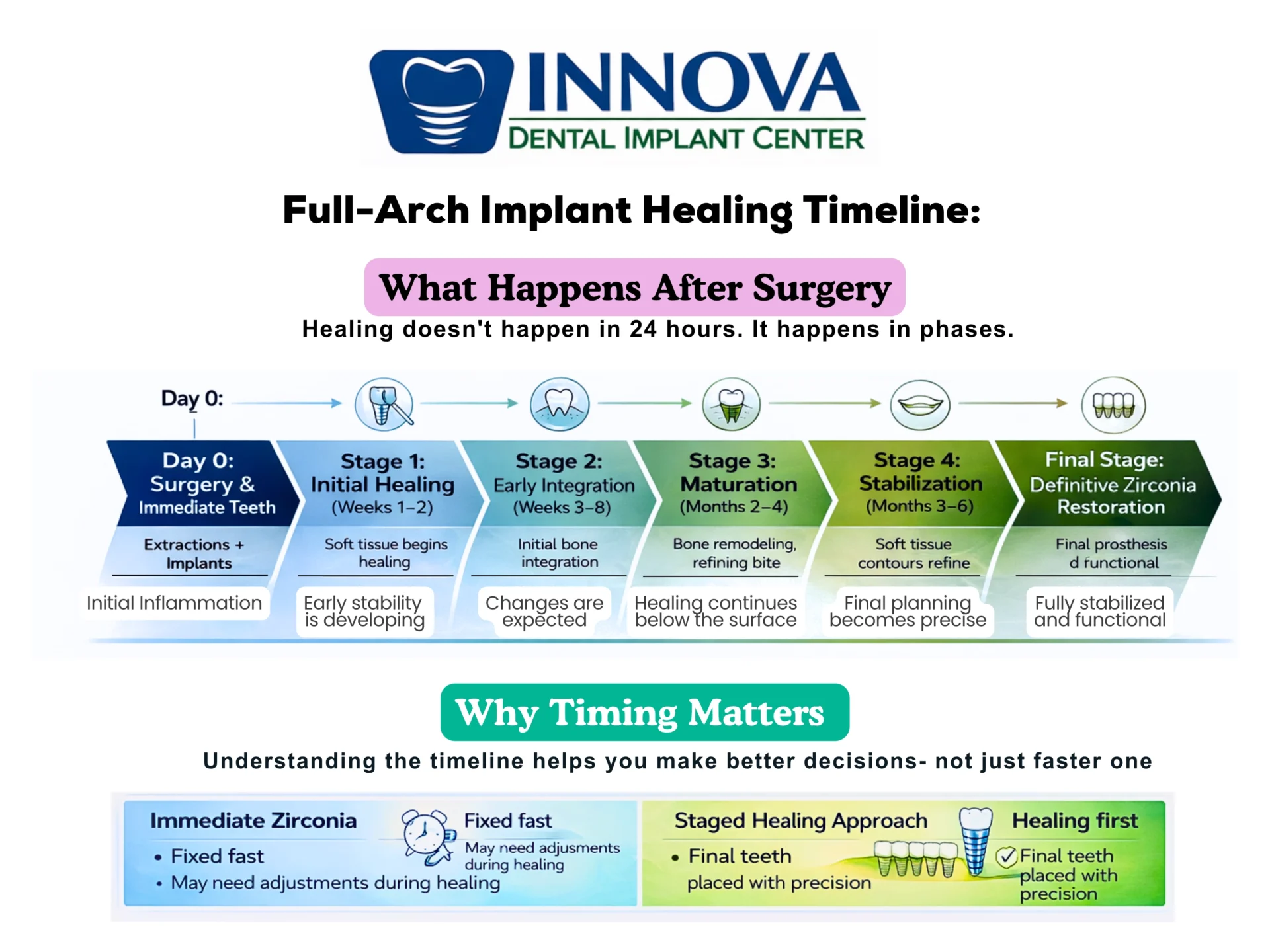
Immediate zirconia teeth can be possible, but they are not always the safest or most predictable option. Even when teeth are delivered quickly, the overall treatment is not finished in 24 hours. Your gums, bone, and bite still need time to stabilize.
After surgery:
- Bone is integrating
- Soft tissue is remodeling
- The bite continues to evolve
Implant teeth may be placed early, but healing continues for several months. During this time, natural changes such as normal gum shrinkage can occur. These changes may create small spaces between the gum and the prosthesis and may require adjustments or redos.
For many patients, this is why the “24‑hour teeth” concept can work against long‑term success. What sounds like an advantage may actually introduce avoidable revisions later, turning it into a flawed concept.
The Tradeoffs Behind Permanent Teeth in 24 Hours
These changes are expected parts of the healing process. They are not complications, but they may require follow‑up visits, refinements, or occasional remakes to keep the prosthesis fitting and functioning properly.
Comparison Table: 24‑Hour Zirconia vs. Healing‑First Approach
| Key Difference | 24‑Hour Zirconia Approach | Safer Approach (Healing‑First) |
|---|---|---|
| Timing of Prosthesis | A zirconia‑type fixed prosthesis is attempted immediately and marketed as “zirconia teeth in 24 hours.” | Interim fixed prosthesis delivered in 24 hours; final zirconia delivered after tissues stabilize (about 3 months). |
| Adaptability During Healing | Limited adaptability. Early tissue changes may create gaps or require revisions. | Interim materials adapt more easily as gums and bone remodel, allowing controlled refinements. |
| When Final Prosthesis Is Designed | Final design attempted before tissues have stabilized, increasing the chance of later adjustments. | Final design completed after healing, when tissues and bite are more stable and predictable. |
| Risk of Revisions | Higher likelihood of bite adjustments, refinements, or remakes due to early tissue changes. | Lower risk of major revisions because final zirconia is designed on a stable foundation. |
Understanding Zirconia Teeth in 24 Hours-Patient Healing Guide
Material Selection During the Healing Phase: Zirconia vs. Interim High‑Impact Polymers
During full‑arch implant treatment—especially in cases promoted as zirconia teeth in 24 hours—the material used during the healing phase has a major impact on long‑term results.
The key difference at this stage is not strength alone. It is how each material responds as the mouth heals and tissues continue to change.
Zirconia (Definitive Restoration Material)
- High strength and long‑term durability
- Excellent performance once healing is complete
- Rigid structure with limited adjustability during early healing
Interim High‑Impact Polymer Prosthesis (Used During Healing)
- Easier to adjust as tissues remodel
- Supports progressive refinement during the healing phase
- Allows optimization of occlusion, contour, and esthetics before the final design
Zirconia is a rigid, definitive material. It does not adapt as bone and soft tissue remodel after implant placement. As healing continues, changes in bite or contour may require clinical adjustments, and in some cases, more extensive modification.
Interim high‑impact polymer prostheses, by contrast, allow controlled refinement throughout the healing phase. This flexibility helps the clinician improve fit, function, and esthetics before transitioning to the final zirconia restoration.
A staged, prosthetically driven approach—using adaptable materials during healing and reserving zirconia for the definitive phase—reduces variability and supports more predictable long‑term outcomes.
Why Immediate Zirconia Often Requires Follow‑Up Adjustments
A zirconia prosthesis requires several precise steps, including digital planning, design, milling, sintering, finishing, and fit verification. When all of these steps are compressed into a 24‑hour window, efficiency becomes the priority while the patient is still healing. As a result, follow‑up visits for bite adjustments or refinements are common and expected.
Are “Full Zirconia” Prostheses Truly Full Zirconia?
Not always. In many full‑arch restorations, the teeth portion is zirconia, while the pink gingival portion is made from composite or a polymer‑based material. This hybrid design is widely used and clinically acceptable. Patients should understand which materials are being delivered and how future adjustments will be managed.
Zirconia Teeth in 24 Hours: Considerations During Early Healing
Zirconia is an excellent definitive material. The key question is when it should be introduced. Early use may involve:
- Limited adaptability to tissue changes
- Occlusal refinements as healing progresses
- Ongoing adjustments
- Use of protective appliances
For patients considering full‑arch zirconia implants, timing is just as important as material selection.
A Critical Clarification: You Will Still Receive Zirconia — Just at the Right Time
Most full‑arch implant treatments end with a zirconia prosthesis. The difference between approaches is not whether zirconia is used, but when it is introduced. Soft tissue naturally shrinks and reshapes during the first few months after implant placement. Introducing zirconia before tissues stabilize may lead to avoidable revisions.
Immediate zirconia may offer short‑term gratification, but it does not eliminate the biological healing process. Many providers who advertise “zirconia in 24 hours” also note that “not all patients qualify,” which can feel confusing and may function more as marketing language than clinical guidance.
A More Predictable Approach: Prioritizing Biology Over Speed
A biologically aligned workflow focuses on:
- Prosthetically driven planning
- Preserving bone and soft tissue
- Using transitional materials during healing
- Delivering zirconia once tissues stabilize
This approach is not about delaying treatment. It is about sequencing each step correctly to support long‑term predictability.
Final Thoughts: Speed vs. Long‑Term Stability
Zirconia is a high‑quality material, and full‑arch implant therapy can be life‑changing. But speed should not be confused with completion. Before choosing zirconia teeth in 24 hours, patients should understand:
- Healing continues beyond the first day
- Zirconia is rigid during early healing
- Follow‑up care is normal
- “Full zirconia” often refers to a hybrid prosthesis
- Zirconia is still the final material — introduced at the biologically appropriate time
The most important factor is not how quickly teeth are delivered, but how well the treatment is planned for long‑term success.
Botton Line :
The promise of “zirconia teeth in 24 hours” can sound appealing, but speed does not replace biology. Healing continues long after the first day, and tissues naturally change as bone and soft tissue remodel. Introducing a rigid, definitive material like zirconia too early may lead to avoidable refinements, not because something went wrong, but because the body is still stabilizing. A staged approach that uses adaptable materials during healing and reserves zirconia for the definitive phase respects this biology and supports long‑term comfort, function, and predictability.
Most full‑arch implant treatments still end with a zirconia restoration. The real difference between treatment philosophies is not whether zirconia is used, but when it is introduced. By prioritizing tissue stability, prosthetic accuracy, and proper sequencing, patients receive a final zirconia prosthesis that is designed on a stable foundation—not rushed into place before healing is complete. In full‑arch implant therapy, long‑term success comes from thoughtful planning, not from compressing every step into a single day.
Does It Hurt to Start With a Zoom Consultation?
A Zoom consultation isn’t a diagnosis — but it can be a smart first step. You can ask Dr. Rivera questions, understand your options,
and decide whether an in-person evaluation makes sense.
Schedule a Zoom Consultation with Dr. Rivera
Related reading:
What is the FP1 Smile System?
The harsh reality of FP3
Frequently Asked Questions
Are zirconia teeth in 24 hours truly permanent?
Zirconia teeth in 24 hours are placed quickly, but they are not usually the final restoration. Healing continues for several months, and minor refinements or adjustments are common as the tissues stabilize. The long‑term zirconia prosthesis is typically delivered once healing is complete.
Is zirconia better than acrylic for full‑arch implants?
Zirconia is stronger and more durable long term, while high‑impact polymer provisional teeth adapt better during early healing—so many clinicians use a provisional first, then switch to zirconia once the tissues stabilize.
Do all patients qualify for zirconia teeth in 24 hours?
No. Candidacy for zirconia teeth in 24 hours depends on factors like bone quality, implant stability, bite forces, and overall health. In reality, only a very small number of carefully selected patients can safely qualify.
Final Thoughts
Choosing zirconia teeth in 24 hours can feel exciting, but long‑term success depends on respecting the healing process. Tissues continue to change during the first few months, and introducing zirconia too early may lead to avoidable refinements. A staged, biologically aligned approach—using adaptable materials first and zirconia once the foundation is stable—offers a more predictable path to comfort, function, and lasting results.