
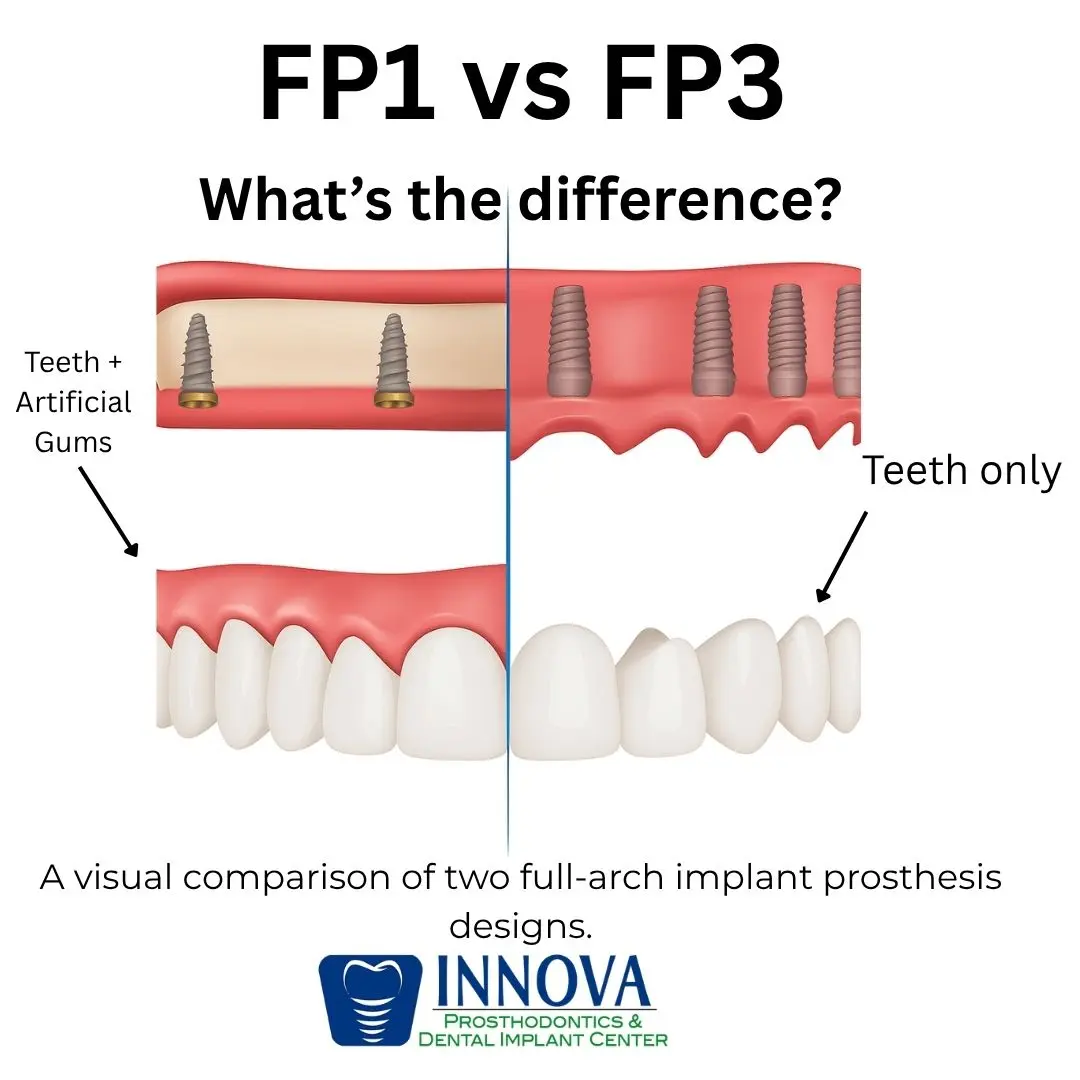
FP1 vs FP3 Dental Surgery: What’s the Difference?
What Is FP1 vs FP3 Dental Surgery?
Today, one of the most common questions patients ask is about FP1 vs FP3 dental surgery. Although both are fixed full-arch implant solutions, they are designed for different clinical situations. Therefore, understanding the differences can help you choose the treatment that best matches your anatomy, goals, and long-term expectations.
At Innova Prosthodontics, we routinely evaluate both FP1 and FP3 treatment options rather than recommending a one-size-fits-all solution. Every patient receives a comprehensive evaluation that includes a CBCT scan, digital treatment planning, and a prosthetic assessment before we recommend any treatment.
FP1 vs FP3: What Is FP1 Dental Surgery?
FP1 surgery recreates the appearance of natural teeth emerging from your gums. The goal is to preserve as much of your natural anatomy as possible while achieving the most natural appearance and feel and helping reduce food traps.
FP1 Dental Surgery: What Does It Involve?
Generally, treatment focuses on:
- Preserving healthy bone whenever possible rather than removing it unnecessarily.
- Using grafting procedures to help support natural-looking gum contours.
- Precisely positioning implants, often using 6–8 implants per arch.
- Over-engineering is the key. In many cases, placing implants in a more upright position reduces the need for heavily angled implants.
- Supporting restorations that closely resemble natural teeth.
What Does FP1 Look Like?
Additionally, many patients are drawn to FP1 because it offers:
- Teeth that appear to emerge naturally from the gums.
- Minimal or no visible pink prosthetic material.
- No “gums sitting on top of gums.”
- A highly natural appearance.
- Fewer areas where food may become trapped.
- A fixed solution that closely mimics natural teeth.
Who May Be a Candidate for FP1?
Some patients may qualify for FP1 if they have:
- Enough healthy bone to support dental implants.
- Healthy gums with a natural shape.
- Little to no bone and gum tissue loss.
- A desire for teeth that look like they naturally emerge from the gums.
- A desire for a smile that feels more like natural teeth, helps reduce food getting trapped, and is easier to keep clean.
However, not everyone qualifies for FP1. In some cases, missing teeth, gum disease, or long-term denture wear have already caused significant bone loss. As a result, creating the natural-looking result that FP1 is designed to achieve may no longer be possible. In those situations, FP3 may provide a healthier, more predictable, and long-lasting outcome.
FP1 vs FP3: What Is FP3 Dental Surgery?
Historically, clinicians developed FP3 surgery to replace both the teeth and the gum and bone tissue that patients had already lost over time. However, treatment philosophies can vary between providers. In some practices, clinicians intentionally reduce bone to create the space needed for an FP3 prosthesis. As a result, the prosthesis does not always replace tissue that patients previously lost—it may also replace bone and gum tissue that clinicians reshaped during treatment.
Nevertheless, this approach is not appropriate for every patient. In some cases, bone reduction is necessary and may be the best treatment option. However, every patient deserves an individualized evaluation to determine whether preserving natural bone with an FP1 approach is possible before recommending bone reduction.
FP3 Dental Surgery: What Does It Involve?
Typically, treatment focuses on:
- Creating restorative space through bone reduction to accommodate the prosthesis.
- Delivering a prosthesis that replaces both the teeth and the gum tissue with artificial pink material.
What Does FP3 Look Like?
Likewise, FP3 restorations generally include:
- Replacement teeth.
- Artificial pink gum material.
- Additional prosthetic support to replace lost tissues.
- Fixed implant-supported function.
Who Is a Candidate for FP3 Dental Surgery?
FP3 may be appropriate for patients with:
- Significant bone loss.
- Advanced periodontal disease.
- Long-term denture wear.
- Collapsed facial support.
- Anatomy that limits the ability to predictably achieve an FP1 result.
When comparing FP1 vs FP3 dental surgery, understanding the amount of remaining bone and gum tissue is one of the most important factors during treatment planning.
FP1 vs FP3 Dental Surgery: Does FP3 Always Require Bone Reduction?
Is Bone Reduction Always Necessary?
No, not always.
In fact, this is one of the most common misconceptions. Some FP3 treatment plans involve alveoloplasty, which reshapes portions of the jawbone to create sufficient restorative space for the FP3 prosthesis.
However:
- The amount of reduction varies considerably.
- Not all FP3 cases require extensive reduction.
- Surgical recommendations should be based on individual anatomy rather than a standardized approach.
Therefore, patients should ask their treating dentist or prosthodontist whether bone reduction is anticipated, why it is recommended, and whether FP1 is available as an alternative.
FP1 vs FP3 Dental Surgery: Is FP1 Better Than FP3?
Not necessarily.
Instead, ask this question:
Which option is more appropriate for your specific situation?
Advantages of FP1
- Highly natural appearance.
- Minimal or no artificial gum material.
- Preservation of existing tissues whenever feasible.
- Teeth that emerge naturally from the gums.
Limitations of FP1
- More demanding treatment planning.
- Requires favorable anatomy.
- May involve additional procedures to preserve or augment tissues.
- Not achievable in every patient.
Advantages of FP3
- Predictable treatment for advanced tissue loss.
- Ability to restore facial support.
- Fixed function in complex situations.
- Well-established long-term outcomes.
Limitations of FP3
- Presence of prosthetic gingiva.
- Larger prosthesis.
- Additional hygiene considerations.
- Bone reduction may be recommended in selected cases.
Why Don’t All Dentists Offer FP1?
FP1 treatment can be more technically demanding.
Why Is FP1 More Technically Demanding?
It often requires:
- Detailed prosthetic planning.
- Precise implant positioning.
- Close coordination between surgery and restoration.
- Advanced digital workflows.
- Careful case selection.
Why Does Experience Matter?
For example, one of the most common misconceptions we hear during consultations is that every patient needs the same type of full-arch restoration. Instead, treatment planning begins by evaluating what can be preserved—not simply what can be replaced.
Furthermore, at Innova Prosthodontics, treatment planning begins with CBCT imaging, facial analysis, digital smile design, and prosthetic planning before surgery is recommended. This process helps us determine whether preserving natural bone and gum tissue with an FP1 approach is achievable.
Is FP1 More Expensive Than FP3?
What Factors Affect the Cost?
Naturally, costs vary depending on:
- The complexity of treatment.
- Additional grafting procedures.
- The number of implants required.
- Laboratory procedures.
- Materials used.
- Geographic location.
Because every patient presents differently, a comprehensive examination—including CBCT imaging and digital records—is necessary before determining the most appropriate treatment plan and associated fees.
Questions to Ask About FP1 vs FP3 Dental Surgery
If you are considering FP1 vs FP3 dental surgery, ask:
Questions About Your Treatment
- Am I a candidate for FP1?
- Will my final restoration contain pink material?
- Is bone reduction anticipated?
- Why are you recommending FP3 instead of FP1?
- What alternatives exist?
Questions About Results
- Can I see examples of similar cases?
- What maintenance will be required long-term?
Ultimately, these conversations can help ensure that your expectations align with the proposed treatment.
The Bottom Line
In summary, FP1 and FP3 are not competing treatments—they are different solutions designed for different clinical situations.
- FP1 focuses on recreating the appearance of natural teeth emerging from the gums whenever anatomy allows.
- FP3 focuses on replacing both teeth and lost supporting tissues to provide fixed function and esthetics when additional prosthetic support is needed.
Ultimately, your prosthodontist determines the most appropriate treatment through careful diagnosis, thoughtful planning, and a clear understanding of your anatomy, oral health, and smile goals. This article provides educational information only. A comprehensive clinical evaluation is the best way to determine whether FP1 or FP3 is the most appropriate treatment for your individual needs.